Planning an africa itinerary requires balancing vast distances with the specific wildlife and landscapes you want to see. Travellers with two weeks can enjoy a highly focused regional safari, while those with a full month can cross multiple borders. Focusing your route on efficient flight paths and logical border crossings prevents travel fatigue and maximises your time on the ground.
Planning Your Africa Itinerary: The Essentials
Africa is a massive continent, and you cannot simply hop between major parks by train or quick domestic flights. Distances are huge, and cross-border logistics require careful planning. Before locking in your route, you need to understand the primary aviation hubs, the costs involved, and the seasonal weather patterns.
International Flight Hubs
Most international travellers will fly into one of four major aviation hubs. In Southern Africa, O.R. Tambo International Airport (JNB) in Johannesburg and Cape Town International Airport (CPT) are your primary entry points. From Johannesburg, you can catch regional flights on Airlink or Safair to the Kruger region, Victoria Falls, or Maun in Botswana. In East Africa, Jomo Kenyatta International Airport (NBO) in Nairobi and Addis Ababa Bole International Airport (ADD) handle the bulk of international arrivals.
If you are trying to connect Southern and East Africa on a longer trip, Kenya Airways operates a direct flight between Victoria Falls (VFA) and Nairobi, which saves you from flying all the way back down to Johannesburg to connect.
Budget and Costs
An Africa trip can range from a $150-a-day overland camping tour to a $2,000-a-night fly-in luxury safari. For a comfortable, mid-range lodge safari, expect to budget between $500 and $800 per person per day. This usually covers accommodation, meals, guided game drives, and park conservation fees.
Internal flights will add significantly to your budget. Light aircraft transfers between bush airstrips (often called “bush flights”) are standard in places like Botswana and Tanzania. A typical 45-minute hop on a Cessna Caravan can cost $300 to $450 one way.
The Best Time to Visit
Your route heavily depends on the season. The dry season in Southern Africa runs from May to October. During these months, temperatures hover around 20°C to 25°C (68°F to 77°F) during the day, but nights can drop to near freezing in desert areas like Namibia. The lack of rain forces wildlife to congregate around permanent water sources, making game viewing highly predictable.
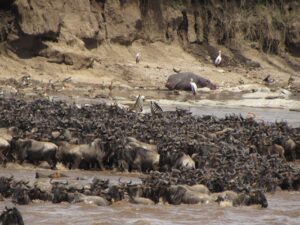
In East Africa, the dry season from July to October aligns with the most dramatic river crossings of the wildebeest migration. If you are trying to decide between the two major East African countries during this window, comparing The Great Migration: Kenya vs Tanzania, Month by Month will help you pinpoint exactly where you need to be for the best sightings.
Classic 2-Week Africa Itinerary: East Africa Highlights
If your priority is vast savannahs, massive herds, and Maasai culture, this 14-day route through Kenya and Tanzania is the gold standard.
- Days 1-2: Nairobi, Kenya. Arrive at NBO. Spend your first full day recovering from jet lag. Visit the David Sheldrick Wildlife Trust to see orphaned elephants and the Giraffe Centre in the Karen neighbourhood.
- Days 3-6: Masai Mara National Reserve. Take a 45-minute Safarilink flight from Nairobi’s Wilson Airport (WIL) to the Mara. Spend four days tracking lions, cheetahs, and massive herds of wildebeest. Opt for a private conservancy like Mara North or Naboisho for off-road driving and night drives, which are not permitted in the main national reserve.
- Days 7-10: Serengeti National Park, Tanzania. Fly from the Mara to the Serengeti (usually requiring a quick border stop at Tarime/Migori). The Serengeti is vast, covering over 14,700 square kilometres. Position yourself in the northern sector near the Mara River from July to October, or the southern Ndutu plains from January to March for the calving season.
- Days 11-14: Zanzibar. Take a direct flight from the Serengeti bush airstrips to Zanzibar (ZNZ). Spend your final days exploring the winding alleys of Stone Town and relaxing on the white sands of Nungwi or Paje before flying home.
Classic 2-Week Africa Itinerary: South Africa and Victoria Falls
This route offers the best variety: world-class food and wine, guaranteed Big Five sightings, and one of the world’s most impressive waterfalls. It is highly recommended for first-timers.
- Days 1-5: Cape Town and the Winelands. Arrive at CPT. Spend two days exploring the city—take the cable car up Table Mountain, visit Kirstenbosch Botanical Gardens, and drive the Cape Peninsula to see the penguins at Boulders Beach. Dedicate two days to the Cape Winelands, staying in Franschhoek or Stellenbosch for wine tastings and incredible dining.
- Days 6-10: Greater Kruger. Fly from Cape Town to Skukuza (SZK) or Hoedspruit (HDS). Stay in a private reserve sharing an unfenced border with Kruger National Park, such as the Sabi Sands or Timbavati. The Sabi Sands is globally renowned for its relaxed leopard population. Because vehicles can drive off-road here, your chances of close-up sightings are unmatched.
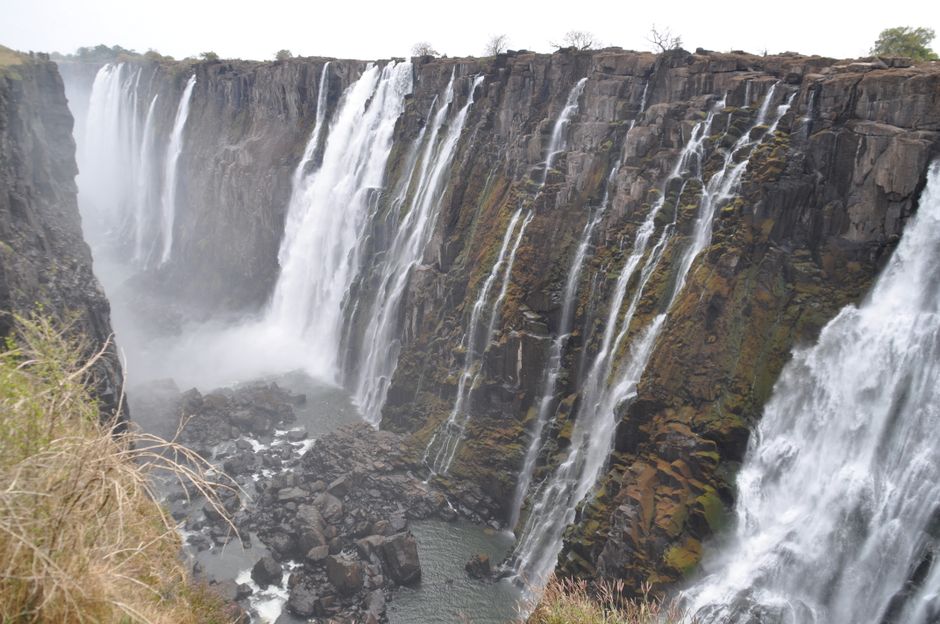
- Days 11-14: Victoria Falls. Fly from Kruger (KMIA airport) directly to Livingstone, Zambia (LVI) or Victoria Falls, Zimbabwe (VFA). View the falls in the afternoon for the best rainbows, take a sunset cruise on the Zambezi River, and book a full-day safari trip across the border into Botswana’s Chobe National Park to see massive elephant herds.
The 3-Week Africa Itinerary: Southern Explorer
If you have 21 days, you can tackle the stark deserts of Namibia and the lush waterways of Botswana. This is a journey of extreme environmental contrasts.
- Days 1-7: Namibia’s Deserts. Fly into Windhoek (WDH). Rent a 4×4 and drive 350 km southwest to Sossusvlei (about a five-hour drive on gravel roads). Climb Dune 45 at sunrise and walk through the skeletal trees of Deadvlei. Continue to the coastal town of Swakopmund, then drive north to Damaraland to track desert-adapted elephants.
- Days 8-11: Etosha National Park. Drive to Etosha, where wildlife viewing revolves around the park’s natural springs and artificial waterholes. During the dry winter months, you can park your car by a waterhole and watch hundreds of animals—rhinos, lions, giraffes, and springbok—take their turns drinking.
- Days 12-16: The Okavango Delta, Botswana. Drop your rental car back in Windhoek and fly to Maun (MUB), Botswana. From here, take a light aircraft into the Okavango Delta. Spend your days gliding through the reed-lined channels in a mokoro (traditional dugout canoe) and taking walking safaris on the islands.
- Days 17-21: Chobe and Victoria Falls. Fly up to Kasane (BBK) to explore Chobe National Park by boat, getting incredibly close to swimming elephants. Finally, cross the border into Zimbabwe or Zambia for a few days at Victoria Falls before flying out.
The Ultimate 1-Month Africa Itinerary: The Grand Tour
With a full month, you do not have to choose between the south and the east. You can build a comprehensive continental tour, though it requires a healthy budget for regional flights.
- Week 1: South Africa. Start in Cape Town for culture, scenery, and wine. Fly to the Sabi Sands for a luxury Big Five safari.
- Week 2: Victoria Falls and Botswana. Fly from Kruger to Victoria Falls. Spend two days at the falls, then transfer by road to Kasane, Botswana. Take a bush flight into the Okavango Delta for a water-based safari experience.
- Week 3: Kenya. Fly from Maun to Johannesburg, then connect to Nairobi. Transfer to the Masai Mara for classic savannah game drives and hot air ballooning over the plains.
- Week 4: Rwanda or Uganda. Fly from Nairobi to Kigali (KGL) in Rwanda or Entebbe (EBB) in Uganda. Spend your final week trekking into the rainforest to sit with mountain gorillas. In Rwanda’s Volcanoes National Park, the trek is generally shorter but permits cost $1,500. In Uganda’s Bwindi Impenetrable Forest, the terrain is tougher, but permits are $800.
Itinerary Comparison Overview
| Itinerary | Duration | Best For | Estimated Cost (Per Person) |
|---|---|---|---|
| East Africa Highlights | 14 Days | The Great Migration, open savannahs, beaches | $6,000 – $10,000 |
| South Africa & Victoria Falls | 14 Days | Big Five, food and wine, dramatic scenery | $5,000 – $9,000 |
| Southern Explorer | 21 Days | Desert landscapes, water safaris, self-driving | $8,000 – $12,000 |
| The Grand Tour | 30 Days | Seeing the best of the entire continent, gorillas | $15,000 – $25,000+ |
Mistakes to Avoid on Your Route
Cramming in too many countries. Looking at a map, it is tempting to tick off four or five countries in two weeks. In reality, border crossings, layovers in Johannesburg or Nairobi, and light aircraft schedules will eat up entire days. Stick to two countries for a two-week trip. If you are unsure where to focus, review the Best Countries to Visit in Africa to narrow down your priorities.
Ignoring luggage restrictions. If your itinerary includes light aircraft flights (standard in Botswana, Kenya, and Tanzania), you cannot bring hard-sided suitcases. You are strictly limited to 15 kg (33 lbs) in a soft-sided duffel bag that can be squashed into the plane’s small cargo pod.
Skipping health preparations. Many countries require a Yellow Fever certificate for entry, particularly if you are transiting through a risk area. Malaria prophylaxis is also highly recommended for most safari areas, including Kruger, the Okavango Delta, and the Serengeti. Before you book your flights, read up on the necessary Vaccinations and Health Prep for Travel in Africa and consult a travel clinic.
Booking the wrong season for your destination. Wildlife movements change dramatically throughout the year. If you show up in the Serengeti in October expecting to see the migration in the south, you will be disappointed. Always cross-reference your travel dates with the Best Safari Destinations in Africa: Where to Go and When.
Plan Your Trip
When finalising your route, look into regional visa programmes that can save you time and money. The KAZA Univisa, for example, allows you to move freely between Zambia and Zimbabwe for $50, which is ideal if you are visiting Victoria Falls. Many countries, including Kenya and Tanzania, now require e-visas applied for in advance—do not expect to get a visa on arrival.
For more granular details on packing lists, tipping etiquette, and safety advice, head over to our comprehensive Africa guide to ensure you are fully prepared for the trip of a lifetime.